NBT preparation for South African matrics: study plan & guide
Kickstart your NBT preparation with free resources, structured courses, and essential deadlines to boost your matric success in South Africa.

Start your NBT preparation by downloading the free official exemplar booklets from the National Benchmark Test Project, doing at least one timed full-length mock under exam conditions, and booking your test sitting before your target university’s deadline closes.
Three things to do right now:
- Download official exemplar booklets from nbt.ac.za — these are free, authoritative, and the closest thing to the real test.
- Research a structured prep option such as Advantage Learn (online courses and live workshops) or use Asksmarty to match your current results to programmes and check which universities require the NBT for your target faculty.
- Check registration dates on the official NBTP portal and book your sitting early — some university deadlines require you to write as early as May or July, well before final matric exams.
Table of Contents
- What do the NBTs actually test, and how long are the sessions?
- Where to find official NBTP resources and how to register
- A practical multi-week NBT study plan that actually works
- Which South African NBT prep options are worth your time?
- How to pick the right prep option for your situation
- Registration and test-day checklist
- How universities use your NBT results
- Why timed mocks beat topic-only drilling
- Key Takeaways
- What to do with your NBT results: Asksmarty’s free tools
- Useful sources for NBT preparation
- FAQ
What do the NBTs actually test, and how long are the sessions?
There are two separate tests: the Academic and Quantitative Literacy test (AQL) and the Mathematics test (MAT). Both measure academic readiness, but they target completely different skills.
The AQL has two components. Academic Literacy (AL) tests your ability to read and interpret complex academic texts, follow arguments, and understand academic vocabulary. Quantitative Literacy (QL) tests your ability to work with numbers, graphs, and data in everyday contexts — without a calculator. The MAT tests mathematical problem-solving, algebraic reasoning, geometry, and spatial thinking at a level that predicts readiness for first-year university mathematics.
| Session | Test | Typical duration | Key rules |
|---|---|---|---|
| Morning | AQL (AL + QL combined) | 3 hours | No calculators; no bathroom breaks during the session |
| Afternoon | MAT | 3 hours | No calculators; no bathroom breaks during the session |
| Combined sitting | AQL + MAT (same day) | Up to 6 hours | Lunch break between sessions; no electronic devices |
The no-calculator rule catches many learners off guard. QL and MAT both require mental arithmetic and estimation under time pressure, which is exactly why timed practice without a calculator must be part of your routine from week one.
Where to find official NBTP resources and how to register
The single most important preparation step is using the NBTP exemplar booklets as your baseline. These are free, available in multiple languages, and show the exact question style and assessment intent. No paid course replaces them — the NBTP itself advises against “teaching to the test” and does not endorse any commercial provider.
Registration steps:
- Preparing your learners | National Benchmark Test Project
- What to expect | National Benchmark Test Project
- FAQ | National Benchmark Test Project
- NBT 2026 Survival Guide V1.0
- National Benchmark Tests (NBTs) - Free Practice - OLICO Maths Education
- How to Prepare for the NBT: Study Tips & Free Practice
- NBT National Report 2019
- Advantage Learn
- NBT test guide (PracticeTestGeeks)
What to bring on test day (per NBTP test-day rules):
Banned items: calculators, mobile phones, smartwatches, and any other electronic devices. Bringing a banned item can result in disqualification. Leave your phone in the car or at home.
The NBTP FAQ also recommends getting a full night’s sleep and sorting out your transport the day before — small logistics that genuinely affect performance.
A practical multi-week NBT study plan that actually works
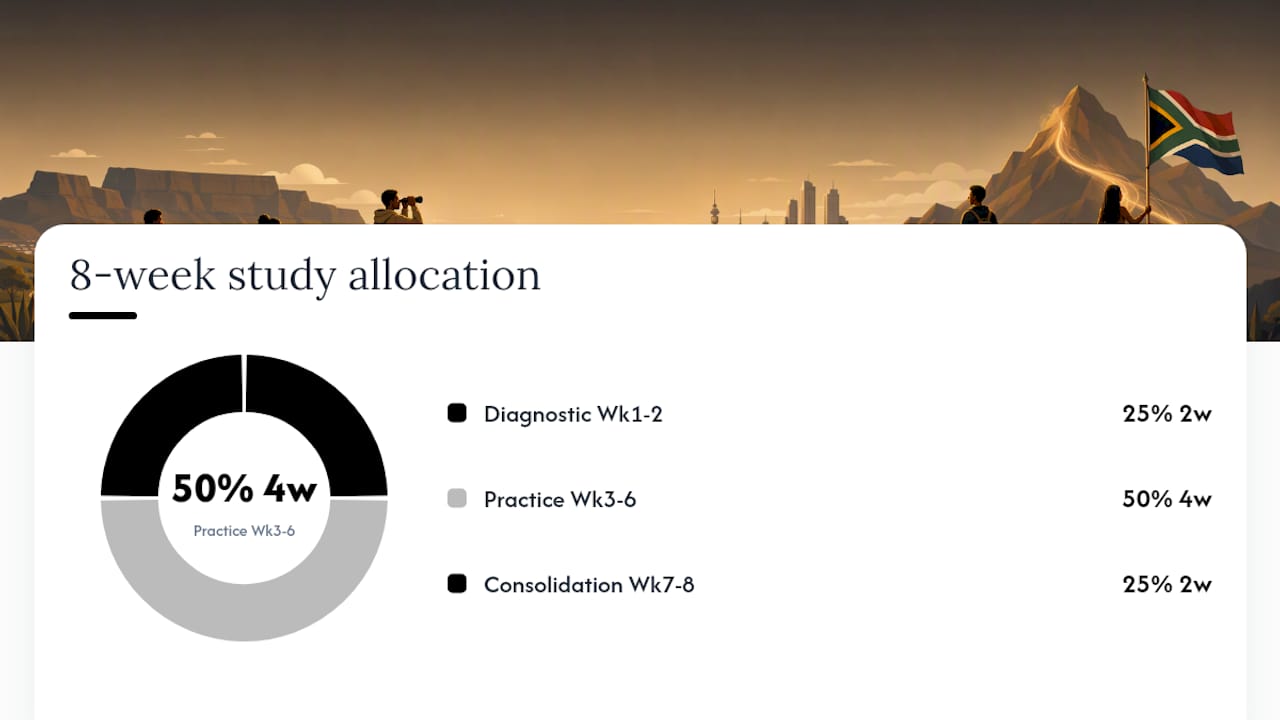
The most effective approach follows three phases: diagnostic, intensive practice, and consolidation. Advantage Learn’s NBT survival guide recommends starting at least 8 weeks out, and earlier is better if you are targeting competitive programmes like medicine or engineering.
Phase 1 — Weeks 1–2: Diagnostic and foundations
- Complete a timed full-length AQL mock using official exemplar questions. Record your score and time per section.
- Complete a timed full-length MAT mock under the same conditions.
- Open an error log (more on this below) and categorise every wrong answer by question type and cause.
- Identify your two weakest sub-skills — these become your daily focus for the next four weeks.
Phase 2 — several weeks of skill-building and volume practice
- For AL: read one academic article or editorial daily. Practise identifying the main argument, the author’s tone, and the logical structure. Time yourself on passage questions.
- For QL: practise graph interpretation, percentage calculations, and data reading without a calculator. Thirty minutes daily is enough if it is consistent.
- For MAT: work through geometry, algebra, and number patterns systematically. Sketch diagrams for every geometry problem — spatial reasoning improves with visual habit.
- Run one full timed mock per week. Review your error log after each one and update your patterns.
Phase 3 — final weeks of consolidation and stamina training
- Simulate a full test day: AQL in the morning, MAT in the afternoon, with a lunch break between. Do this at least twice.
- Focus the final two weeks on your weakest paper. Practise it last in your simulations to build endurance under fatigue.
- Stop introducing new material near the end of preparation period. Consolidate what you know and review your error log patterns.
Common mistakes to avoid:
- Spending more than two minutes on a single question. Mark it and move on.
- Triple-checking arithmetic instead of moving forward — trust your first calculation and return only if time allows.
- Skipping the official exemplar booklets in favour of third-party materials alone. Third-party resources add volume; exemplars show intent.
- Leaving registration until after matric exams. Some faculty deadlines require NBT results months earlier.
Pro Tip: Practise your weakest paper last in every full-day simulation. Fatigue is a real variable on test day, and training under tired conditions is the only way to build the stamina to handle it.
Which South African NBT prep options are worth your time?
Formats range from free self-guided tools to live in-person workshops. The right choice depends on your diagnostic score, how many weeks you have, and whether you need exam technique or subject-level teaching.
| Provider | Format | Practice tests / duration | Price / free trial | What’s included | Best for | Credibility |
|---|---|---|---|---|---|---|
| Asksmarty | Free online tools | Programme matching, APS calculator | Free | APS calculator, programme search, prospectus downloads, admission requirements | Learners mapping NBT/NSC results to programmes and checking entry rules | Independent SA guide; privacy-preserving; 1,700+ programmes |
| National Benchmark Test Project | Official self-study | Exemplar booklets (MAT + AQL) | Free | Official exemplar questions, test rules, FAQ | All learners — the authoritative baseline | Official test operator |
| Advantage Learn | Online self-paced + live workshops | Multiple mock exams; multi-month access | Paid; free sample content available | Mock exams, tutor support, structured course, workshop option | Learners wanting structured course access with tutor feedback | Widely referenced SA provider; published NBT survival guide |
| Seventh Star | In-person workshops | Intensive workshop format | Paid | MAT and AQL exam technique, workshop sessions | Learners seeking intensive workshop-style preparation | Market-recognised workshop provider (SERP-listed) |
| UCT NBT resources | Research reports + teacher resources | Historical performance data | Free | National report, performance analysis, NSC comparison | Learners and teachers wanting data-driven insight into NBT outcomes | University of Cape Town research group |
Trust signals to look for in any paid provider: access to full-length timed mock exams (not just topic drills), a clear refund or cancellation policy, transparent course outlines, and no claim to be “NBTP-endorsed” (no such endorsement exists). Free practice materials from OLICO are also worth downloading for additional MAT volume practice.
How to pick the right prep option for your situation
Your diagnostic mock score is the single most useful input for this decision. Everything else follows from it.
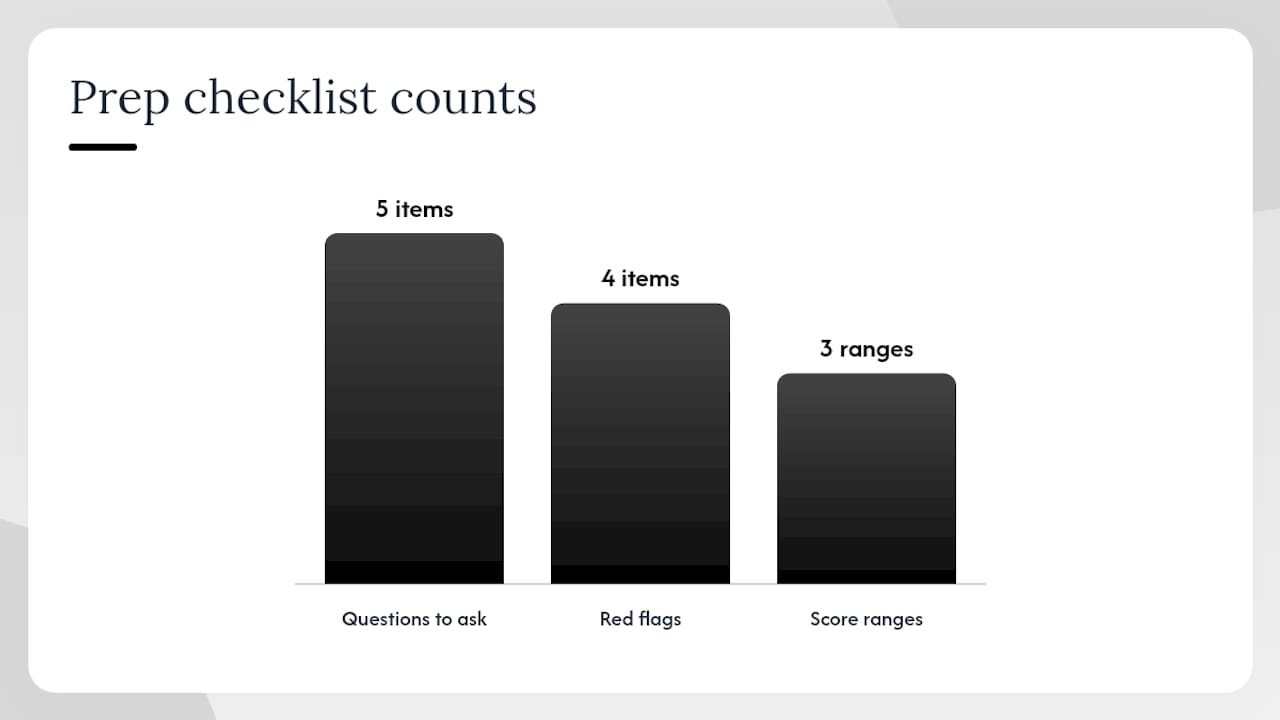
- Run a diagnostic first. Complete one timed mock before spending money on a course. Your score tells you whether you need subject-level teaching (Basic range) or exam technique and pacing (Intermediate range approaching Proficient).
- Count your weeks. Eight weeks or more gives you time for a structured course. Fewer than four weeks means intensive mock practice and error-log review is more efficient than starting a new course.
- Set a budget. Official NBTP exemplars and OLICO practice materials are free. Paid courses from providers like Advantage Learn add structure and tutor feedback — worth it if you are borderline for a competitive programme.
- Know your learning style. Live workshops suit learners who need accountability and real-time feedback. Self-paced online courses suit learners with irregular schedules.
- Define your target outcome. Proficient placement is required for direct entry to some competitive faculties. Intermediate may still meet requirements for many programmes — check your target university’s policy.
Questions to ask any paid provider before enrolling:
- How many full-length timed mock exams are included?
- What is the refund or cancellation policy if I need to withdraw?
- What is the tutor-to-student ratio in live sessions?
- Can you show evidence of learner outcomes or improvement rates?
- Do your materials include official NBTP exemplar questions or only third-party content?
Red flags: a provider with no full-length timed tests, no refund policy, unverifiable testimonials, or one that claims to be officially endorsed by the NBTP. The NBTP does not endorse any commercial course.
Registration and test-day checklist
Register on the official NBTP portal and confirm your venue, ID requirements, and fees before you book transport or accommodation.
Registration checklist:
- Create a candidate account on nbt.ac.za
- Select your preferred test date and venue (check that the date falls within your target university’s deadline)
- Confirm and pay the test fee as listed on the portal
- Upload or verify your ID document
- Print and save your registration confirmation
Test-day checklist (per NBTP what-to-expect guidance):
- Valid South African ID, smart ID card, or passport
- Printed registration confirmation
- Two sharpened HB pencils and an eraser
- Lunch, snacks, and water (no bathroom breaks during each 3-hour session)
- Arrive at the venue by approximately 7:30 AM for check-in
Banned in the exam room: calculators, mobile phones, smartwatches, and all other electronic devices. Follow all invigilator instructions — any disruption or banned item can result in your results being withheld.
Pro Tip: Sort your transport and venue logistics the day before the test. A late arrival or a forgotten ID document cannot be fixed on the morning. Treat the logistics like a separate exam.
How universities use your NBT results
Universities use NBT results in two main ways: as part of the admission decision itself, or to place admitted students into academic support or extended curriculum programmes. Knowing which applies to your target faculty changes how you should interpret your score. The UCT NBT national report provides detailed analysis of how NBT performance relates to NSC results and first-year academic outcomes.
| Placement level | Typical interpretation | Practical next step |
|---|---|---|
| Proficient | Strong academic readiness; meets or exceeds most faculty benchmarks | Apply confidently to your target programmes; check admission requirements per faculty |
| Intermediate | Adequate readiness; may trigger support placement at some universities | Confirm specific faculty requirements; some programmes accept Intermediate with conditions |
| Basic | Significant gaps identified; may affect admission to competitive programmes | Consider a resit, targeted remediation, or explore extended curriculum options |
Each university sets its own policy on how much weight NBT results carry relative to your NSC marks. Some faculties — particularly medicine, engineering, and law — weight NBT results heavily. Others use them primarily for support placement. Always check the specific faculty page at your target institution rather than relying on general guidance.
If your result is Intermediate or Basic, a resit is possible. Check the NBTP portal for available dates and plan your preparation cycle accordingly.
Why timed mocks beat topic-only drilling
The most consistent finding across preparation guides is this: timed, full-length practice under exam conditions produces larger score gains than topic-by-topic revision alone. PracticeTestGeeks and Advantage Learn’s survival guide both point to the same pattern — learners who drill topics without timing themselves consistently underperform on test day because they have never trained the pacing muscle.
Implementation steps for mock practice:
- Schedule one full mock per week from week two onwards. Use official exemplar questions or OLICO practice papers for MAT.
- Replicate exact exam conditions: no calculator, no phone, no interruptions, same time of day as your actual test.
- Time each section strictly. Set a timer and stop when it goes off, even mid-question.
- After each mock, complete your error log before reviewing the answers. Recording your reasoning first reveals where your thinking broke down, not just which answers were wrong.
- After two or three mocks, look for patterns in your error log. Repeating error types (misreading graphs, rushing geometry, skipping QL estimation) are your highest-leverage targets.
Simple error-log template:
| Field | What to record |
|---|---|
| Question type | E.g., graph interpretation, argument structure, algebra |
| Error cause | E.g., misread the question, ran out of time, calculation slip |
| Corrective action | E.g., practise 10 graph questions daily for one week |
| Next review date | Set a date to retest the same question type |
Pro Tip: Limit yourself to a maximum of 2 minutes per multiple-choice question during every practice session. PracticeTestGeeks recommends this as the single most effective pacing rule — mark any question you cannot answer in two minutes and return to it only after completing the rest of the section.
Key Takeaways
Effective NBT preparation combines official NBTP exemplar booklets, structured timed mocks, and an error log reviewed after every session — starting well before your test date.
| Point | Details |
|---|---|
| Start with official exemplars | Download free MAT and AQL exemplar booklets from nbt.ac.za before using any third-party material. |
| Run timed full-length mocks | Complete at least one full mock under exam conditions regularly; practise your weakest paper last to build stamina. |
| Use an error log | Track question type, error cause, and corrective action after every mock to find repeatable patterns. |
| Book your sitting early | Some university deadlines require NBT results from May–July sittings, well before final matric exams. |
| Asksmarty after results | Use Asksmarty’s free APS calculator and programme search to match your NBT and NSC results to available programmes. |
What actually matters in NBT preparation
Most learners treat the NBTs like a content exam — they revise maths topics, read a few passages, and feel ready. The test is designed to resist that approach. The AQL in particular tests reasoning and reading stamina, not memorised content. You cannot cram your way to a Proficient score in Academic Literacy the way you might revise for a history paper.
The preparation method that consistently works is also the least comfortable: sitting down for three hours with a timer running, no calculator, no phone, and working through a full paper without stopping. Most learners avoid this because it is unpleasant. That discomfort is exactly the point. The test is three hours long. If you have never practised for three hours straight, the first time you do it should not be on the actual test day.
The error log matters for a different reason. Undirected practice gives you volume but not direction. Reviewing patterns after two or three mocks tells you whether you are losing time on graph questions, misreading argument structure, or rushing geometry. Each of those has a different fix. Without the log, you practise the same errors more efficiently.
Official exemplars are non-negotiable as a starting point. Third-party materials — including good ones from Advantage Learn and OLICO — are useful for volume. But the NBTP exemplars show you the exact phrasing, the level of abstraction, and the question intent. No commercial material fully replicates that, and starting with anything else means you are calibrating to the wrong target.
What to do with your NBT results: Asksmarty’s free tools
Once your NBT results arrive, the next question is immediate: which programmes do you actually qualify for, given both your NSC marks and your NBT placement? That is exactly what Asksmarty is built for.
Asksmarty gives you a free APS calculator that works entirely on your device — your marks never leave it. Pair that with the programme search across more than 1,700 South African university and college programmes, filtered by your results, faculty, and institution. You can also check university admission requirements to see exactly how each faculty weighs NBT results against NSC marks, and download prospectuses directly. No registration, no fees, no waiting. Search available programmes at South African universities and colleges now and see where your results open doors.
Useful sources for NBT preparation
Use these official and reputable sources to verify dates, download exemplar questions, and access free practice materials. Always confirm current fees and test dates directly on the NBTP portal, as these change each year.
- nbt.ac.za — official exemplar booklets and test rules: Free MAT and AQL exemplar booklets in multiple languages, plus the official test-day rules and FAQ. Start here.
- NBTP FAQ: Answers to common questions about registration, exemplars, and test-day logistics.
- NBTP what to expect: Official list of required items, banned items, and check-in procedures.
- Advantage Learn NBT preparation courses: — Structured online and workshop-based courses with mock exams and tutor support.
- Advantage Learn NBT survival guide: Free downloadable guide covering phased study plans and mock practice strategy.
- OLICO free NBT practice materials: Free downloadable MAT workbooks and online practice aligned to NBT-style questions.
- PracticeTestGeeks NBT preparation guide: Study tips, timed practice advice, and error-journal guidance.
FAQ
How do you prepare for the NBT effectively?
Start with the free official exemplar booklets from nbt.ac.za, complete at least one timed full-length mock per week, and keep an error log to track repeatable mistakes. An 8-week structured plan gives most learners enough time to move from Intermediate to Proficient range.
Is the NBT difficult?
The NBT is designed to test reasoning and academic readiness rather than memorised content, which makes it harder to cram for than a typical school exam. Time pressure is the most common cause of underperformance, not knowledge gaps alone.
What is a good NBT score?
Proficient is the strongest placement and meets direct entry requirements for most competitive programmes. Intermediate is adequate for many programmes but may trigger academic support placement at some universities. Check your target faculty’s specific policy, as requirements vary.
How much does the NBT test cost?
Test fees are listed on the official NBTP portal at nbt.ac.za and must be confirmed there, as amounts can change between test cycles. Registration is completed and paid through the portal directly.
Can I resit the NBT if my score is too low?
Yes. The NBTP offers multiple test sittings throughout the year. Check the portal for available dates and plan a full preparation cycle before your resit, using your error log from the first attempt to focus your practice.
Recommended
Published 2026-08-08 · AskSmarty is an independent guide. Confirm anything time-sensitive on the official source.